

Few longevity treatments have more hype around them than NAD+ IV therapy. Influencers swear by it. Wellness clinics charge thousands for it. The science, as is often the case, sits somewhere between the marketing and the skeptics.
Here’s the honest version: NAD+ is a real, important molecule with a real biological role in aging. NAD+ IV therapy can produce meaningful benefits in the right patients for the right reasons. It is also oversold, overpriced, and sometimes done badly in clinics that treat it as a stand-alone magic bullet rather than one tool in a longevity toolkit.
At Aesura Health in Hackensack, NJ, our physicians use NAD+ IV therapy as part of a broader precision longevity program.
This guide explains NAD+IV, what the evidence says, who benefits, and how to think about cost versus value.
What Is NAD+ and Why Does It Matter for Aging?
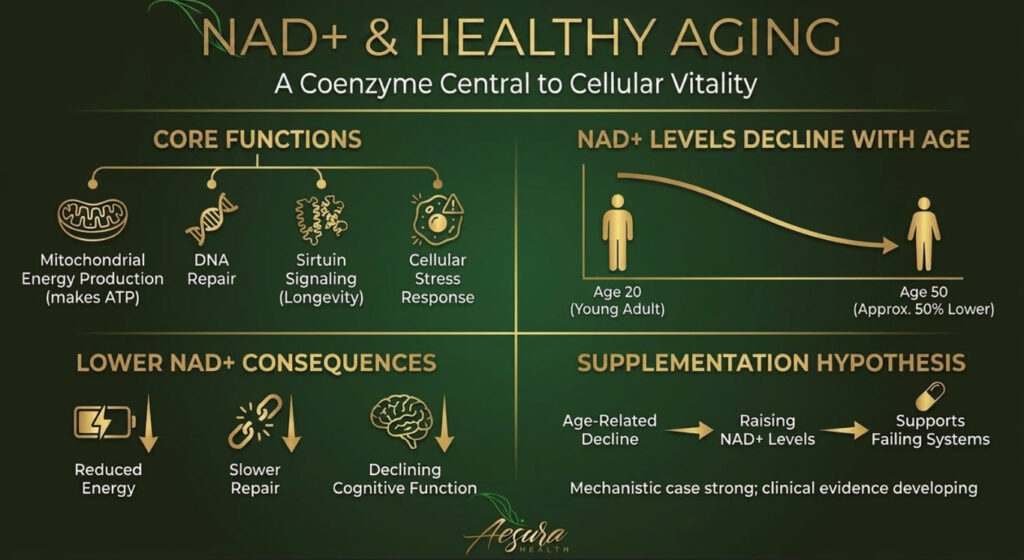
NAD+ (nicotinamide adenine dinucleotide) is a coenzyme present in every cell of the body. It is central to mitochondrial energy production, DNA repair, sirtuin signaling (a family of longevity-associated proteins), and the cellular stress response. Without adequate NAD+, mitochondria don’t make ATP efficiently, DNA repair slows, and cells age faster.
NAD+ levels decline measurably with age, roughly 50% lower by age 50 compared to young adults. Lower NAD+ is associated with reduced energy, slower repair, declining cognitive function, and many of the cellular hallmarks of aging.
The hypothesis behind NAD+ supplementation is straightforward: if NAD+ declines with age and supports the systems that fail in aging, raising NAD+ levels should help. The clinical evidence is still developing, but the mechanistic case is strong.
Does NAD+ IV Therapy Actually Work?
Here is where honesty matters. NAD+ IV has strong mechanistic plausibility and accumulating clinical experience, but the randomized controlled trial evidence in humans is limited compared to other longevity interventions.
What we do have evidence for:
- NAD+ IV elevates serum NAD+ levels and downstream metabolites (verified in pharmacokinetic studies)
- Clinical reports of improved energy, mental clarity, and recovery in patients with documented low NAD+
- Animal data showing improved mitochondrial function, neuroprotection, and metabolic benefits
- Oral precursors (NR, NMN) have small RCTs showing NAD+ elevation and modest metabolic benefits
What we don’t have yet:
- Large RCTs proving NAD+ IV extends lifespan or healthspan in humans
- Definitive proof that IV delivery is meaningfully better than oral precursors for most uses
- Standardized dosing protocols agreed upon across longevity medicine
This is why we frame NAD+ IV as evidence-supported but not yet evidence-conclusive. It is a reasonable intervention for the right patient, with appropriate expectations, in the context of a broader longevity plan.
Who Actually Benefits Most from NAD+ IV?
From clinical experience, the patients who report the most consistent benefit from NAD+ IV are:
- Adults over 40 experiencing persistent fatigue, brain fog, or low recovery capacity
- Patients with high oxidative stress or inflammatory burden (chronic illness, intense training, long COVID)
- People in recovery from substance use (NAD+ has a clinical role in addiction recovery protocols)
- Patients on combined longevity protocols who want to support mitochondrial function
- High-performing executives, athletes, or shift workers seeking energy and cognitive support
The ideal patient profile for NAD+ IV
- Younger patients with already-optimal energy and recovery
- Patients whose primary issue is hormonal (low thyroid, low T, perimenopause) — fix the hormones first
- Patients with primary sleep deprivation or untreated metabolic disease — fix those first
NAD+ IV is not a substitute for fixing what is actually broken. If your fatigue is driven by low testosterone, untreated sleep apnea, or insulin resistance, no amount of NAD+ will fix it. We screen for these before recommending IV.
How Is NAD+ IV Administered and What Does It Feel Like?
A typical NAD+ infusion is 250 to 1000 mg of NAD+ delivered slowly over 1.5 to 4 hours. Slow administration matters — too fast causes uncomfortable side effects (chest tightness, abdominal cramping, anxiety, flushing) that are dose-rate dependent, not toxicity.
Most patients receive an initial loading series — 4 to 6 infusions over 2 to 4 weeks — followed by maintenance every 2 to 8 weeks based on response. Combination with other IV components (B vitamins, glutathione, magnesium) is common.
Most patients describe the experience as relaxing once the rate is dialed in. Some report a clear lift in energy, focus, and recovery beginning within hours and lasting days to weeks. Others notice subtle, cumulative effects over a series.
NAD+ IV vs. Oral NR or NMN — Which Is Better?
This is the most debated question in NAD+ therapy. Both raise NAD+ levels. They do so differently.
IV NAD+
- Delivers NAD+ directly into the bloodstream, bypassing absorption and first-pass metabolism.
- Produces rapid, large elevations in serum NAD+.
- More expensive, requires clinic time.
- Subjectively, many patients describe stronger and faster effects.
Oral NR (Nicotinamide Riboside) or NMN (Nicotinamide Mononucleotide)
- Precursor molecules that the body converts into NAD+.
- Convenient daily dosing.
- Cheaper per day.
- Effective at raising NAD+ levels over time.
- Best for sustained maintenance.
In our practice, the typical approach is IV loading + oral maintenance: use IV to rapidly elevate levels and produce a felt clinical effect, then use oral precursors to sustain the elevation between infusions.
What Does NAD+ IV Cost — and Is It Worth It?
NAD+ IV therapy at quality clinics typically ranges $400–$1,200 per infusion, depending on dose, IV protocol, and add-ons. A series of 4–6 infusions runs $1,600–$7,000 plus maintenance.
Is it worth it? Depends entirely on what you’re trying to accomplish and what else you’re doing. For a patient who has optimized hormones, sleep, training, and metabolic health and still has room to improve energy and recovery, NAD+ IV can be a high-value addition. For a patient who hasn’t done the foundational work, NAD+ IV is an expensive band-aid.
At Aesura Health, we discuss this honestly with every patient. We will tell you when NAD+ IV makes sense for you and when your time and money would be better spent on something else first.
FAQs About NAD+ IV Therapy in NJ
What is NAD+ and why does it decline with age?
NAD+ (nicotinamide adenine dinucleotide) is a coenzyme essential to mitochondrial energy production, DNA repair, and the cellular stress response.
NAD+ levels decline roughly 50% by age 50 due to increased consumption (DNA damage, inflammation) and reduced production. Lower NAD+ contributes to many hallmarks of aging.
How long does a NAD+ IV session take?
Typical sessions run 1.5 to 4 hours, depending on dose. Slower administration is more comfortable; faster administration can cause transient chest tightness, cramping, or flushing that resolves when the rate is reduced.
Are NAD+ IV side effects dangerous?
No. Most side effects are dose-rate dependent and resolve immediately when the infusion rate is slowed. Common transient effects include flushing, chest pressure, abdominal cramping, and mild anxiety. Serious adverse events are rare when administered by trained clinical staff.
How quickly will I feel results?
Many patients report noticeable energy, focus, or recovery improvement within hours to days of the first infusion, with cumulative benefit over a loading series. Others notice subtler effects over weeks. Response varies based on baseline NAD+ status, overall health, and what else is going on metabolically.
Is NAD+ IV better than oral NR or NMN?
Both raise NAD+ levels. IV produces faster, larger elevations and often a stronger felt clinical effect. Oral precursors are cheaper, more convenient, and effective for sustained maintenance. The optimal strategy is often IV loading followed by oral maintenance.
How often should I get NAD+ IV?
Most protocols begin with a loading series of 4 to 6 infusions over 2 to 4 weeks, then maintenance every 2 to 8 weeks based on response. Your individual protocol depends on goals, baseline labs, and the rest of your longevity plan.
Is NAD+ IV safe for everyone?
It is well-tolerated in most healthy adults. Caution is warranted in patients with significant cardiovascular disease, active cancer, pregnancy, or severe liver/kidney impairment. We screen carefully before recommending.
Does insurance cover NAD+ IV?
No. NAD+ IV is considered wellness/longevity therapy and is not covered by insurance. We provide invoices for FSA/HSA submission where eligible. We discuss cost openly so you can make an informed decision.
Can NAD+ IV be combined with peptides, HRT, or other longevity treatments?
Yes. NAD+ IV pairs well with peptide therapy, hormone optimization, and recovery tools like HBOT and red light therapy. We integrate it into a complete longevity protocol rather than treating it as a standalone.
Where can I get NAD+ IV therapy in New Jersey?
Aesura Health in Hackensack, NJ, offers physician-supervised NAD+ IV therapy as part of our precision longevity program. Located at The Shops at Riverside, 390 Hackensack Ave, we serve Bergen County and the greater New Jersey area. Book a consultation at aesura.janeapp.com.
The Aesura Difference
NAD+ IV is offered at countless wellness clinics — and most of them have no way to tell you whether it is the right intervention for you, no plan to integrate it with the rest of your health, and no follow-up to track whether it actually worked.
At Aesura Health, NAD+ IV is one component of a comprehensive longevity program led by Dr. Jijoe Joseph and Dr. Nancy Nguyen. Before recommending IV, we assess your hormones, metabolic health, sleep, mitochondrial markers, and overall longevity picture. If NAD+ IV is not the right answer, we tell you that. If it is, we integrate it with peptide therapy, hormone optimization, biological age testing, and our Longevity Lounge recovery tools. Our approach is physician-led, evidence-based, and built for results that compound over time.
Ready to Find Out if NAD+ IV Is Right for You?
- Schedule online at aesura.janeapp.com
- Visit us at The Shops at Riverside, 390 Hackensack Ave, Hackensack, NJ 07601
- Call 201-983-2582 Monday – Sunday
- Follow us on Instagram @aesura.health for more physician-led longevity education
———
References
- Imai S, Guarente L. NAD+ and sirtuins in aging and disease. Trends in Cell Biology. 2014;24(8):464–471.
- Yoshino J, et al. Nicotinamide Mononucleotide Increases Muscle Insulin Sensitivity in Prediabetic Women. Science. 2021;372(6547):1224–1229.
- Martens CR, et al. Chronic nicotinamide riboside supplementation is well-tolerated and elevates NAD+ in healthy middle-aged and older adults. Nature Communications. 2018;9:1286.
- Grant R, et al. A Pilot Study Investigating Changes in the Human Plasma and Urine NAD+ Metabolome During a 6 Hour Intravenous Infusion of NAD+. Frontiers in Aging Neuroscience. 2019;11:257.
- Brakedal B, et al. The NADPARK study: A randomized phase I trial of nicotinamide riboside supplementation in Parkinson’s disease. Cell Metabolism. 2022;34(3):396–407.
———
Disclaimer
This article is for educational purposes only and does not constitute medical advice. Treatment decisions are individualized and based on a comprehensive medical evaluation, clinical judgment, and informed patient consent. Some therapies discussed may not be FDA-approved for the indications described and are used within physician-supervised, individualized protocols. As with any medical intervention, potential risks, benefits, and alternatives are discussed before initiation. Aesura Health adheres to evolving federal oversight, including the SAFE DRUGS Act of 2025, emphasizing appropriate prescribing, accredited sourcing, and continuous clinical monitoring.
