



Reviewed and medically verified by the physicians at Aesura Health. Last updated: May 2026.
If you’ve spent years on skincare products that haven’t quite delivered, or you’ve tried
microneedling and chemical peels, but need a deeper reset, Fraxel laser resurfacing is often the next step that actually moves the needle.
Fraxel is the original and still considered the gold standard fractional laser. It’s been on the market for nearly two decades. The technology has been refined, the protocols have been studied, and the results – when delivered by an experienced physician — are some of the most predictable and
impressive in non-surgical skin rejuvenation.
At Aesura Health in Hackensack, NJ, our physicians use Fraxel to treat patients with acne scars, sun damage, fine lines, uneven texture, melasma, and the cumulative wear of time.
Here’s how it works, what to expect, and how to think about whether it’s right for you.
What is Fraxel Laser Treatment in NJ?
Fraxel is a medical-grade fractional laser, meaning it delivers thousands of microscopic energy beams into the skin to trigger a natural collagen-rebuilding cascade. At Aesura Health in Hackensack, NJ, physicians utilize the Fraxel Dual platform to treat acne scars, deep sun damage, melasma, and fine lines. The procedure takes 20 to 40 minutes and relies on intact surrounding tissue to accelerate healing.
This is the key insight: you don’t resurface the whole face at once — you treat a fraction of the surface deeply, and the surrounding skin heals it. That’s why Fraxel can deliver powerful results with shorter recovery than older, fully ablative lasers.
There are two main Fraxel platforms used clinically: Fraxel Dual (which combines two wavelengths — 1550 nm for deeper dermal remodeling and 1927 nm for surface pigmentation and sun damage) and the original Fraxel Re: store. The choice depends on what your skin needs.
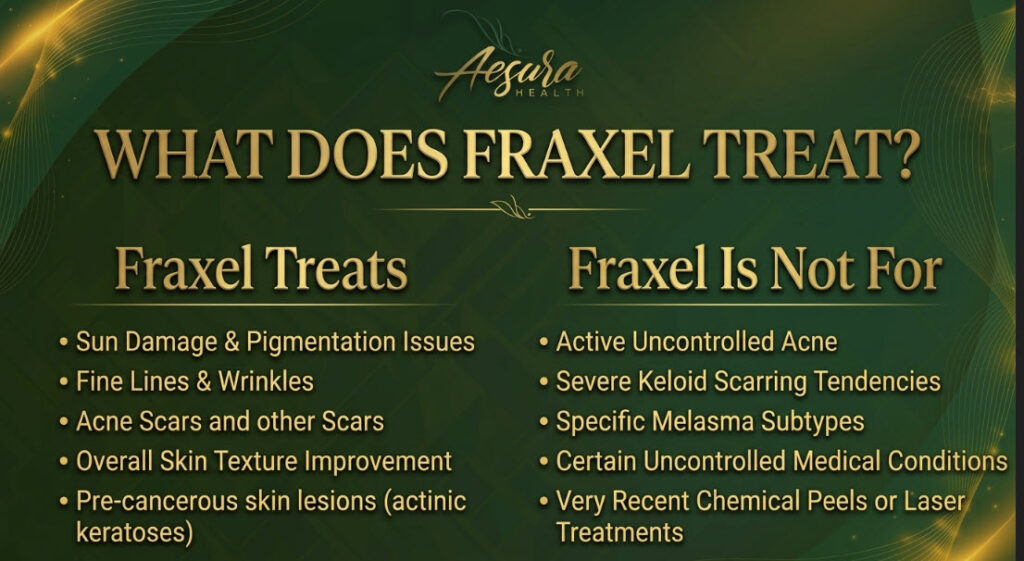
What Does Fraxel Treat — and What Does It Not Treat?
Is Fraxel Safe for All Skin Types?
Fraxel is safe for a wide range of skin types when delivered by an experienced provider — but skin type matters. Patients with darker skin (Fitzpatrick IV–VI) require lower energy settings, careful pre- and post-treatment skin preparation, and protocols designed to minimize the risk of post-inflammatory hyperpigmentation (PIH).
Patients with melasma require particular care. Fraxel can help melasma, but it can also worsen it if energies are too aggressive or the skin is not properly prepared. This is one of the clearest examples of why physician-led laser treatment matters.
At Aesura Health, we assess your skin type, history, current medications (isotretinoin within the last 6 months is generally a contraindication), and goals before designing your Fraxel protocol. Settings are individualized — not pulled off a standard menu.
What Does Fraxel Treatment Feel Like?
A topical numbing cream is applied 30–60 minutes before treatment. During the procedure, you’ll feel a warm prickling heat sensation. Most patients describe it as tolerable rather than painful.
The treatment itself takes 20–40 minutes, depending on the area treated (full face, neck, chest, hands). Cooling air is used throughout to keep you comfortable.
What Is the Fraxel Recovery Timeline?
Recovery varies based on the depth and intensity of your treatment.
Days 1–2
Skin is pink to red, similar to a moderate sunburn. Mild swelling, particularly around the eyes, the morning after, is common and resolves quickly.
Days 3–5
Skin begins to feel rough or sandpapery as the treated micro-zones begin to flake off. This is your skin shedding the damaged tissue. Gentle cleansing, consistent moisturizer, plus high-SPF sunscreen are essential.
Days 5–7
Most of the surface texture has shed. Skin appears brighter and smoother. You can typically resume normal makeup and activities.
Weeks 2–8
Collagen remodeling continues. Improvement in texture, fine lines, and tone is progressive. Most patients see meaningful results by 4–6 weeks, with continued improvement over 2–3 months.
How Many Fraxel Treatments Will I Need?
| Skin Concern | Typical Number of Fraxel Sessions | What to Expect During Treatment |
| Hyperpigmentation & Sun Spots | 1–2 | Pigment generally responds quickly. Expect treated spots to darken and look like coffee grounds before flaking off in a few days. |
| Mild Fine Lines & Uneven Tone | 2–3 | A great baseline for overall, subtle facial rejuvenation. |
| Enlarged Pores & Rough Texture | 3–4 | Smooths out the skin’s surface. Often paired with a great home skincare routine for maximum benefit. |
| Moderate Wrinkles & Aging | 3–5 | Results build cumulatively. The heat from the laser stimulates your body’s natural collagen production over several months. |
| Acne Scars & Surgical Scars | 4–6+ | Deeper tissue damage requires more sessions and patience to effectively remodel the scarred skin. |
| Severe Photoaging (Sun Damage) | 4–6 | For significant, deep-set sun damage, a full series is necessary to see dramatic, restorative changes. |
Most patients need 3 to 5 treatments spaced 4 to 6 weeks apart for significant resurfacing goals like acne scars or extensive sun damage. Maintenance treatments every 6 to 12 months sustain results.
Patients seeking a refresh or treatment for mild concerns may benefit from a single or annual treatment. Your individual plan depends on your skin, your goals, and what other treatments fit into your overall aesthetic plan.
How Does Fraxel Compare to Other Resurfacing Options?
Fraxel vs. Microneedling
Microneedling uses small needles to create controlled injury and stimulate collagen. Less downtime, less dramatic results per session. Fraxel goes deeper with precision for stronger results per session, especially for sun damage and pigment. Many patients benefit from combining both over time.
Fraxel vs. CO2 Laser
Traditional fully ablative CO2 lasers remove all the surface skin. More dramatic results in one session. Significantly longer downtime (7–14 days), higher risk of pigmentary issues, especially in skin of color. Fractional Fraxel offers most of the benefits with much faster recovery.
Fraxel vs. Chemical Peels
Chemical peels (like VI Peel) work on the surface to brighten tone and texture. Excellent for mild pigment and skin freshness. Fraxel penetrates deeper into the dermis for structural remodeling. They are complementary, not competing.
Fraxel vs. Rejuran Microneedling
Rejuran (PDRN) microneedling adds salmon DNA cellular signaling on top of the microneedling stimulus. Excellent for skin quality and gentle remodeling. Fraxel is the more aggressive tool for structural texture concerns. We use both in different patients depending on goals.
FAQs About Fraxel Laser Resurfacing in NJ
What does Fraxel treat?
Fraxel is excellent for acne scars, sun damage and brown spots, fine lines, uneven skin texture, melasma (with careful protocols), surgical scars, and overall skin quality improvement. It is the gold standard fractional laser for non-surgical resurfacing.
How painful is Fraxel?
Topical numbing cream is applied 30–60 minutes before treatment. During treatment, most patients describe a warm prickling sensation. Cooling air is used throughout to keep you comfortable. Most patients tolerate it well.
How long is the downtime after Fraxel?
Most patients have visible pinkness for 1–3 days and a sandpapery texture as skin flakes off for 3–5 days. By day 5–7, most surface effects have resolved, and normal makeup and activities can resume. Deeper treatments have longer recovery.
How many Fraxel sessions will I need?
Most patients need 3–5 treatments spaced 4–6 weeks apart for significant goals like acne scars or extensive sun damage. Mild concerns may resolve in 1–2 treatments. Maintenance every 6–12 months sustains results.
When will I see Fraxel results?
Initial brightness and texture improvement are visible within 1–2 weeks. Collagen-driven improvement continues over 2–3 months. Final results are best assessed at 8–12 weeks after each treatment.
Is Fraxel safe for darker skin tones?
Yes, with proper provider expertise. Patients with Fitzpatrick IV–VI skin types require lower energy settings, careful pre/post-treatment care, and individualized protocols to minimize post-inflammatory hyperpigmentation. This is one of the clearest reasons to choose a physician-led practice over a non-medical spa.
Can Fraxel be combined with Botox, fillers, or other treatments?
Yes. Fraxel works beautifully in combination with neurotoxins (Botox, Daxxify), biostimulators (Sculptra), PRP, microneedling, and medical-grade skincare. The combination is often more effective than any single treatment alone.
How much does Fraxel cost in NJ?
Fraxel pricing varies based on treatment area, depth, and platform. We discuss cost transparently during your consultation, including package pricing for treatment series. Most patients value the result-per-dollar of Fraxel highly compared to other resurfacing options.
Are there any contraindications to Fraxel?
Yes — active skin infection, recent isotretinoin (Accutane) use within 6 months, pregnancy, certain photosensitizing medications, and a few rare skin conditions. We screen carefully before treatment.
Where can I get physician-led Fraxel laser treatment in New Jersey?
Aesura Health in Hackensack, NJ, offers physician-led Fraxel resurfacing as part of our medical spa and aesthetic medicine program. Located at The Shops at Riverside, 390 Hackensack Ave, we serve Bergen County and the greater New Jersey area. Book a consultation at aesura.janeapp.com.
The Aesura Difference for Fraxel Laser Treatment
Fraxel is a powerful tool, but it must be used with experience and care. In an experienced physician’s hands, it produces a consistent, predictable, beautiful skin reset. When used by less knowledgeable practitioners, it can cause complications that are slow or impossible to reverse.
At Aesura Health, your treatment is performed by board-certified physicians Dr. Jijoe Joseph and Dr. Nancy Nguyen.
We assess your skin type, history, current treatments, and goals — and we set the laser to match your individual biology, not a standardized menu. We coordinate Fraxel with the rest of your aesthetic plan: Botox, Sculptra, Skinvive, Rejuran, PRP, peptide therapy, and medical-grade topicals.
Ready to Reset Your Skin at Our New Jersey Clinic??
- Schedule online at aesura.janeapp.com
- Visit us at The Shops at Riverside, 390 Hackensack Ave, Hackensack, NJ 07601
- Call 201-983-2582 Monday – Sunday
- Follow us on Instagram @aesura.health for more physician-led longevity education
———
References
Manstein D, et al. Fractional photothermolysis: A new concept for cutaneous remodeling using microscopic patterns of thermal injury. Lasers in Surgery and Medicine. 2004;34(5):426–438.
Alexiades-Armenakas MR, et al. The spectrum of laser skin resurfacing: nonablative, fractional, and ablative laser resurfacing. Journal of the American Academy of Dermatology. 2008;58(5):719–737.
Hu S, et al. Fractional CO2 laser combined with low-dose 5-aminolevulinic acid photodynamic therapy versus fractional CO2 laser alone for moderate to severe acne scars: A randomized split-face controlled study. Lasers in Medical Science. 2021;36(7):1499–1507.
Bencini PL, et al. Fractional laser skin resurfacing for the treatment of photoaging: a comparative study of 1927 nm thulium and 1550 nm erbium-doped fiber lasers. Journal of Cosmetic and Laser Therapy. 2017;19(4):217–222.
Wat H, et al. Application of Intense Pulsed Light in the Treatment of Dermatologic Disease: A Systematic Review. Dermatologic Surgery. 2014;40(4):359–377.
———
Disclaimer
This article is for educational purposes only and does not constitute medical advice. Treatment decisions are individualized and based on a comprehensive medical evaluation, clinical judgment, and informed patient consent. Some therapies discussed may not be FDA-approved for the indications described and are used within physician-supervised, individualized protocols. As with any medical intervention, potential risks, benefits, and alternatives are discussed before initiation. Aesura Health adheres to evolving federal oversight, including the SAFE DRUGS Act of 2025, emphasizing appropriate prescribing, accredited sourcing, and continuous clinical monitoring.
