



In the world of functional medicine and health optimization, few topics are generating as much excitement as peptide therapy. Once a niche treatment reserved for elite athletes, peptides have moved into the mainstream as a powerful tool for anti-aging, weight loss, injury recovery, and cognitive enhancement.
With all the buzz, it can be difficult to separate the science from the hype. What exactly are these molecules, and how can they change the way you age and perform?
What Are Peptides?
To understand peptides, we have to look at the building blocks of life: amino acids.
You are likely familiar with proteins, which are long chains of amino acids that build muscle, enzymes, and tissue. Peptides are simply shorter chains of amino acids, typically comprising fewer than 50 amino acids linked together.
They are naturally occurring biological molecules that are already present in every cell of your body. There are over 7,000 known peptides in the human body, each with a specific function.
How Do Peptides Work?
Think of peptides as biological messengers, communicating messages between your cells.
Their primary job is cellular signaling. Peptides travel through the body and bind to receptors on the surface of cells, acting like a key in a lock. Once the “key” turns, it triggers a specific reaction or biological process.
Many peptides work by mimicking and modulating existing physiological pathways.
Studies have shown that peptides can help support the body in:
- Releasing more Growth Hormone naturally.
- Reducing inflammation in a specific tendon.
- Stimulating the production of melanin.
- Increasing insulin sensitivity.
The Broad Spectrum of Peptide Therapy Applications
The versatility of peptide therapy is what makes the practice revolutionary. Because different peptides target different receptors, treatment can be highly customized to your specific health goals.
1. Injury Recovery and Pain Management
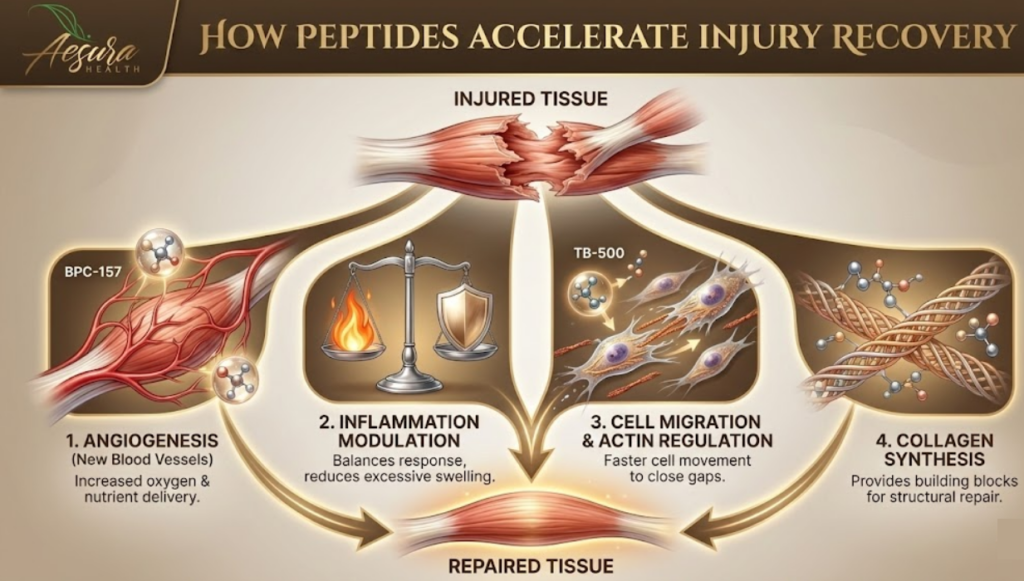
Perhaps the most famous application is tissue repair. Peptides like BPC-157 (Body Protection Compound) and TB-500 (Thymosin Beta-4) may help accelerate the healing of ligaments, tendons, and muscles. Peptides have been shown to reduce systemic inflammation and promote angiogenesis (the formation of new blood vessels), which drives nutrient-rich blood to injured areas.
2. Weight Loss and Metabolic Health
This category has dominated the headlines recently. GLP-1 agonists (like Semaglutide – Ozempic) are peptides that mimic a hormone naturally released after eating. They regulate appetite, slow gastric emptying, and enhance the body’s ability to handle sugar intake, potentially leading to significant and sustained weight loss.
Triple agonist Retatrutide is in phase 3 clinical trials and is anticipated to offer new options for metabolic management by working as an additional glucagon receptor.
Aesura Health’s Dr. Jijoe Joseph explains the benefits of Retatrutide for weight loss in the video below:
3. Anti-Aging and Hormone Optimization
As we age, our natural production of growth hormone declines, which can lead to muscle loss, fat gain, and poor sleep. Peptides known as Secretagogues (such as CJC-1295 and Ipamorelin) can stimulate the pituitary gland to release your body’s own natural stores of growth hormone. This may help reduce the side effects of synthetic HGH while potentially improving skin elasticity, muscle tone, and sleep quality.
4. Cognitive Function (Nootropics)
Certain peptides can cross the blood-brain barrier to improve neuroplasticity. They are used to enhance memory, focus, and mental clarity, and are currently being studied for their neuroprotective properties against cognitive decline.
For example, Semax has been researched for enhancing focus and learning, BDNF helps strengthen connections between brain cells (often described as “brain fertilizer”), and Cerebrolysin has been used internationally to support brain recovery and cognitive health. Together, these compounds represent a promising area of research in brain optimization and neuroplasticity.
5. Sexual Health
Peptides like PT-141 are studied to work on the central nervous system to increase libido and sexual arousal in both men and women, offering an alternative to traditional blood-flow-based medications. Oxytocin, often referred to as the “bonding hormone,” is also being researched for its role in emotional connection, intimacy, and sexual well-being. Peptide-based products are FDA-approved for treating hypoactive sexual desire disorder in premenopausal women.
Peptide products are now FDA-approved for treating hypoactive sexual desire disorder in premenopausal women.
Exploring the Latest Peptide Studies
The science of peptides is evolving rapidly. Current research is validating what practitioners have seen in clinics for years.
- Metabolic Disorder Studies
Recent clinical trials on GLP-1 peptides, such as the SELECT study on Semaglutide, including over 17,000 patients, have shown not only significant weight reduction but also cardiovascular benefits, reshaping how we treat obesity and heart health.
- Tissue Regeneration Studies
Studies published in orthopedic journals are increasingly looking at peptides as viable adjunct therapies for post-surgical recovery, noting their ability to speed up fibroblast migration (the cells that build tissue). For example, a study conducted through the Department of Orthopaedics at National Taiwan University Hospital showed peptide BPC-157 has tissue-stimulating effects through the JAK-STAT signaling pathway.
- Longevity Studies
“Senolytic” peptides represent a new frontier of research. Emerging research is exploring the relationship between chronic inflammation and aging. Researchers are reviewing how targeting the accumulation of “zombie cells” (senescent cells) may help reduce inflammatory burden and support healthier cellular function over time. Pre-clinical studies on animal cells in the Diabetology journal show peptides can potentially mitigate pancreatic inflammation while improving insulin sensitivity.
Answers to Common Questions About Peptide Therapy
Are peptides steroids?
No. Anabolic steroids are synthetic versions of testosterone that shut down your body’s natural hormone production. Peptides are signaling molecules that stimulate your body to produce its own hormones or perform specific functions naturally.
How are peptides administered?
The most effective administration method for the majority of peptides is a small subcutaneous injection (using a tiny insulin needle) into body fat. It is virtually painless and ensures high absorption.
Is peptide therapy safe?
Peptide therapy can be well-tolerated when appropriately prescribed and monitored, as many peptides are designed to interact with natural physiological signaling pathways. However, peptides are biologically active compounds and are not inherently risk-free. Safety depends on proper patient selection, medical oversight, dosing, and ongoing laboratory monitoring.
For this reason, peptide therapy should only be obtained through a licensed medical provider using reputable compounding pharmacies to ensure purity, accuracy of dosing, and quality control. Regular follow-up and lab testing are essential to assess effectiveness, monitor for potential side effects, and adjust treatment as needed.
Experience the Aesura Health Difference
Peptide therapy is not a one-size-fits-all solution. It requires a deep understanding of endocrinology and physiology to tailor the right protocol for your body.
At Aesura Health, we are not just following the peptide trends. We are leading with deep experience. Serving patients throughout New Jersey and across the United States, our team has extensive experience in peptide therapy, Medicine 3.0, and functional medicine. We possess the broad knowledge required to navigate complex peptide treatments safely and effectively.
Whether you are looking to heal a nagging injury, reclaim your metabolic health, or turn back the biological clock, we are here to guide you.
Ready to see what peptides can do for you? Schedule your consultation with Aesura Health today.
Disclaimer:
Many peptides used in clinical practice are compounded medications and are not FDA-approved for specific indications. They are prepared by licensed compounding pharmacies pursuant to a patient-specific prescription and have not undergone the same FDA review as FDA-approved drugs.
As a physician-run medical practice, Aesura Health adheres to evolving federal oversight, including the SAFE DRUGS Act of 2025, emphasizing appropriate prescribing, accredited sourcing, and continuous clinical monitoring. Peptide therapy should only be pursued under licensed physician supervision with regular follow-up and lab evaluation.
Information provided on this website is for educational purposes only and does not constitute medical advice. Treatment decisions are individualized and based on a comprehensive medical evaluation, clinical judgment, and informed patient consent. Not all patients are candidates for peptide therapy, and outcomes may vary. As with any medical intervention, potential risks, benefits, and alternatives are discussed before initiation.
